Search & AI
How AI Search Visibility Differs From Traditional SEO
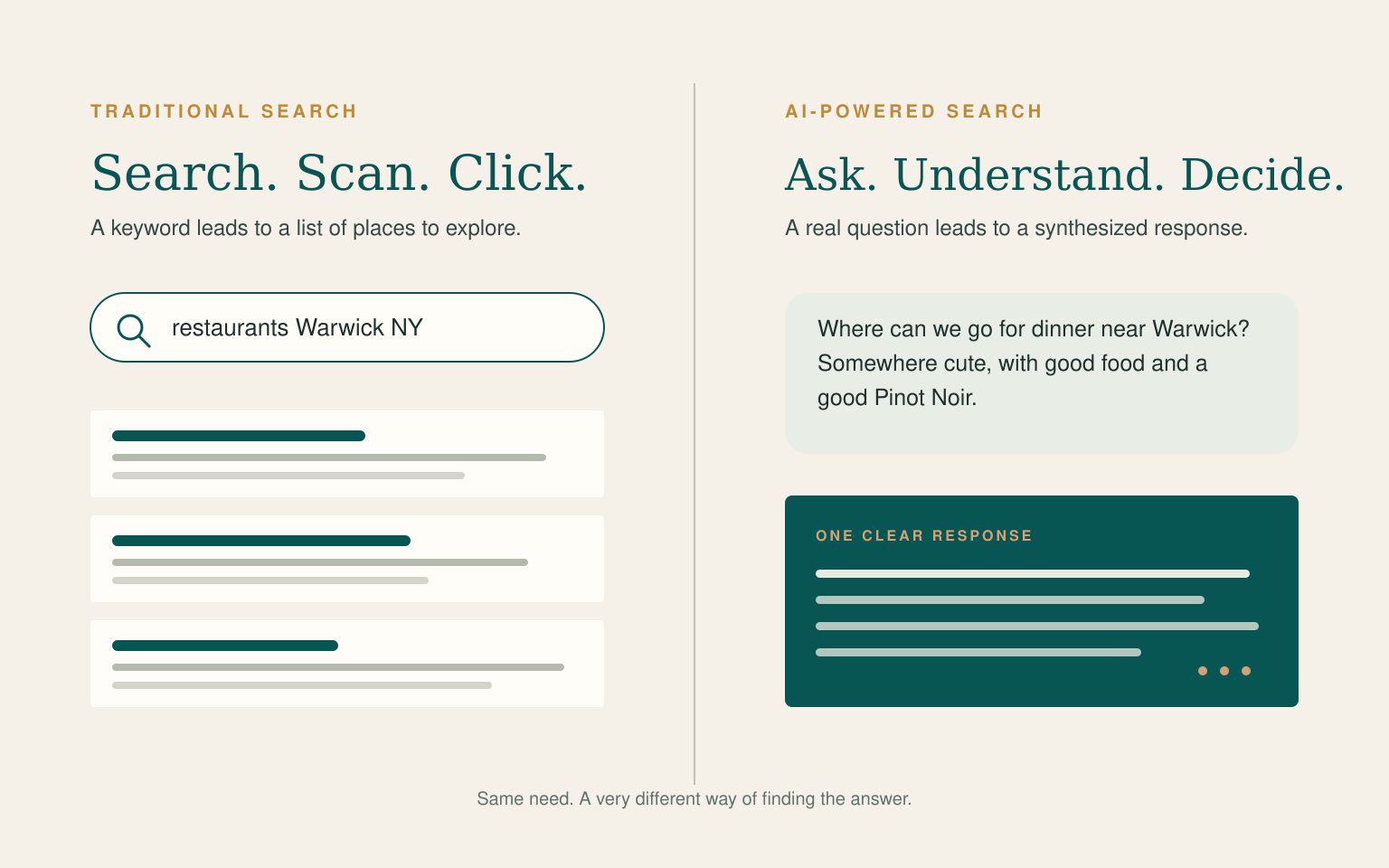
“Where can we go for dinner near Warwick? Somewhere cute, with good food and a good Pinot Noir.”
A few years ago, you might have searched “restaurants Warwick NY” and clicked through half a dozen links trying to find the right place. Now, you can ask an AI tool the whole question. You can explain where you want to go and what kind of night you’re looking for.
That’s a different way to search. And for businesses, it raises a fair question:
“Wait. I finally figured out SEO. Now there’s something else?”
I know. Let’s make this manageable.
What’s the difference between SEO and AI search visibility?
Traditional search engine optimization, or SEO, helps search engines find, understand, and rank your website. Think useful content, clear page titles, accurate business information, and a site that works on your phone.
AI search visibility builds on that foundation. It considers how tools like ChatGPT and Google’s AI search features might find and use information about your business when putting together an answer.
With traditional search, you’re often trying to earn a place in a list of results. With AI search, your business may also become part of the response itself.
Here’s what that can look like:
- “Hair salon near me” becomes “Who near Vernon is good at covering grays but keeping the color looking natural?”
- “Custom cakes Sussex County” becomes “Where can I get a birthday cake that’s dairy-free and still tastes like something people actually want to eat?”
- “Marketing consultant NJ” becomes “Who can help me explain what my business does without making it sound like every other company?”
More detail. More context. Much closer to how we actually talk.
Your business could be exactly what someone needs. But if those useful details never make it onto your website or other reliable online sources, they’re harder to find and use.
You know what makes your business special. But have you actually explained it anywhere?
It’s easy to leave out things that feel obvious to you. They may be exactly what a potential customer wants to know.
So, are we breaking up with SEO?
No. You still need it.
Google says its existing SEO best practices still apply to its AI search features. A clear, useful, accessible website still matters.
You’ll also hear AEO (answer engine optimization) and GEO (generative engine optimization). Because apparently we needed more acronyms.
The practical starting point is familiar: explain what you do, answer real questions, and back up your claims.
Can someone guarantee your business will get recommended by ChatGPT? No. You can improve how your business shows up online, but you don’t get to choose what an AI tool recommends.
Where do you start?
1. Does your website actually explain what you do?
You know your business inside and out. Someone visiting your website for the first time doesn’t. Can they tell what you offer and whether it’s right for them? If you serve a specific area, is that clear too?
“Helping businesses thrive” sounds nice, but it doesn’t tell people what you actually do. If you build websites, say that. If you help local businesses get found online, say that. Make it easy for someone to recognize, “Okay, this is what I need.”
2. Put the good details online.
Do you offer curly-hair cuts? Private dining? Marketing experience with utility buyers? Say so. The thing you casually mention on a call could be the very reason someone chooses you.
3. Answer the slightly awkward questions, too.
“Can I afford this?” “How long will it take?” “Do I need to know what I’m doing before I call you?” Helpful answers give people something to work with and a reason to take the next step.
4. Give people a reason to believe you.
Share examples, results, and what you’ve learned. Then check that your website, business listings, and profiles agree on the basics. If Instagram says one thing and your website says another, which version should anyone believe?
You don’t need to turn your life into a content calendar. Start with the information that helps someone choose you.
Would you choose you, based on what’s online?
That’s the question I’d start with.
Does your online presence explain what makes your business worth considering? Or does your best sales pitch happen only after someone gets you on the phone?
Think about the things you explain on those calls. Some of that probably belongs on your website.
AI Search Visibility Audit
Not sure how your business shows up?
My AI Search Visibility Audit looks at how your business appears across search and AI tools, with a practical plan for where to focus first.